1/10 - Rally at ORyon

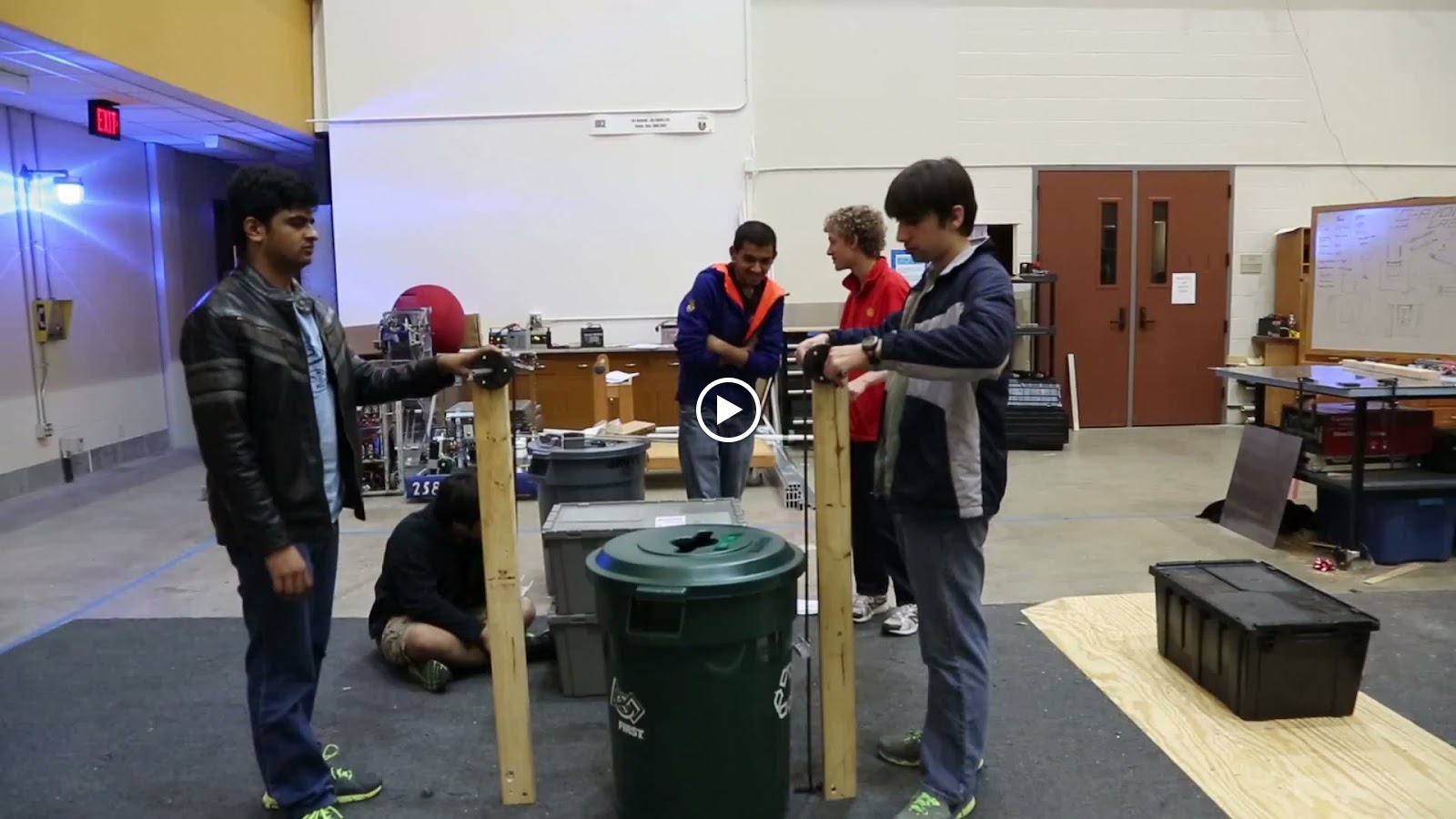
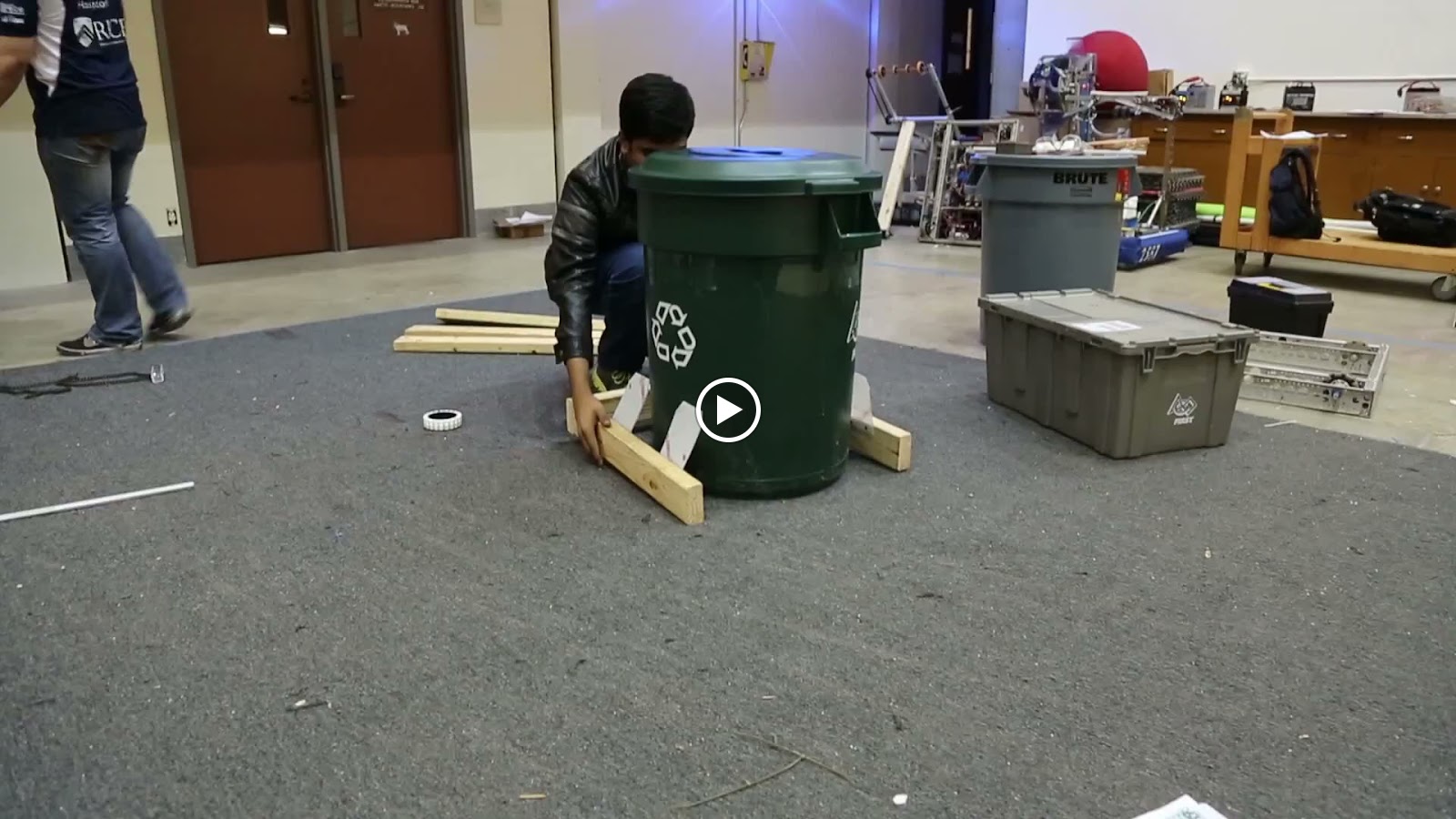
The team was again relocated to Ryon's Lab here at Rice University to provide a more spacious working environment. The focus for the day included continuing work on the prototype, as well as finalizing our FRC season (competition) design on CAD.
Electrical Subdivision


The team spent the morning cutting and stripping wires to accommodate for a new power distribution module that just arrived. Also, they completed the assembly for 2 of the three power distribution boards will we need for our three planned robots.


Programming Subdivision


Veteran programmers worked alongside newer "codelings" to try and score the maximum number of points during the robot's autonomous mode; tested the basic code for this on our prototype robot.


Prototyping + Mechanical + Design

These three subdivisions collaborated to adjust and finalize our 2015 FRC robot's final design scheme - weighed the pros and cons of various drive trains (etc.) - and continued their work on our prototype from last week. A smaller subsection comprised of experienced members + mentors of each of these divisions also tried to optimize the Beetle Juice robot design for the 2015 playing field.

1/9 - We scheme unto the night.

Discobots and their mentors stayed at Carnegie Vanguard after school until 9PM! We would have stayed later, but the staff needed to close the school. Apparently, we're a liability.Who knew :P This was our first meeting with our new mentors from Bechtel who will devote every Monday and Friday for the rest of the FRC season.

Design: During the meeting we debated over various functions of the robot. They have up till the end of next meeting to finalize the robot's design drivers.  The kinks can be worked out later, but we will have our final design ideas by then.


[CAD placeholder]

Prototyping: Further lift work on our practice robot- screwed a frame together to stabilize the REV rails. Still have yet to test it! There's also rollers put together last meeting that should fit perfectly on the rails.
before
after
rollers for the rail

Electrical: Worked on the roboRIO electronics test board, adding connectors to two batteries. It now functions! :D Bought all the parts we foresee using for this season from Houston's Electronic Parts Outlet.


Programming: We wrote some test code to get current and accelerometer data. We used the roboRio (powered by a power adapter from our mentor Phil) to test the on board accelerometer. Conclusions: Its nifty, except for the gravity. Without a three axis gyroscope, the accelerometer includes acceleration due to gravity which does leave room for inaccuracy. It's too bad a gyroscope wasn't integrated, but this just leaves more work for us. We plan on accumulating the acceleration to find velocity. Hopefully we can get an accurate velocity with this system, further testing will come soon. We also pushed some basic prototyping code for the new electronics test boards that allows us to control motor speeds.

[as a side note, Nolan doesn't know what gravity is]
[Nolan here, we need to turn off gravity. only programmers will understand my problems]

1/8 - Bruh, do you even lift?!

We met after school today at Carnegie Vanguard High School! Today's focus was the lift, which must be designed to lift heavy totes and containers approximately 60 inches. We ran into a couple big problems, especially with torsion on the REV rails.

Prototyping + Electrical: Lift work! Our prototype robot now has four REV rails attached,


CAD: Further refining all CAD designs, especially the lift. I stumbled across them making a hard decision between different motors, each with different torques, speeds, and weights. This is extremely important to optimize for the purposes of our robot- the more torque and speed the better, but with that comes a lot more weight.


DO YOU EVEN LIFT? WE [almost] DO!

1/6 - Of all shapes and sizes.


>> Take a look - Our mentors finished their Betelgeuse robot in under 3 days! <<

The students returned to school after their winter vacation today. Today was an organizational day as we brought everything back from R13D's ORyon Labs ... as well as a productive work day with tweaking done to our wide prototype drive train, strategy discussions, and CAD work.

Design + CAD:
A lot of people may not realize that the the robot simply has to fit within the 28in x 42in x 78in box during transport, BUT before the match we can extend it out to our heart's desire. We plan to use this to our advantage by having our manipulator extend out farther than we originally thought we could by unfolding our manipulator and locking it.


For this design we are prototyping we plan to use the new Rev Robotics Linear Lift by making use of their new extrusion. You can find their products here


Controls:
The electrical team began working on our second prototyping board. This will be the second of three planned for prototypes. Two will run off the old control system and VEX Cortexes and one will use the new control system. The new components will be transferred to our final robot once we build it. Programming continued review over the new code and control systems. All new programmers are required to write code for a sample robot with predefined parameters (4 motor drive, encoder, pneumatic brake, pneumatic launcher) before we get to the actual robot code.

1/5 - Prototype, prototype.

We have moved everything out of the ODEK and into Ryon Labs. All sub teams are working from Ryon Labs now, here at Rice University. Special shout out to the ORyon faculty for letting us borrow their work space.

Top-down view of Ryon Labs with Team ORyon and the Discobots

Prototyping: We finished the wide drive train below. It is designed to lock in and traverse over the bump and totes. A lift would be placed on top of this so we could lift the totes or cans and stank them one by one as they are placed by other teams. We stayed up till 2:00 AM tinkering with it to make it drivable! The electrical team wired up a test board using pre-2015 components and a VEX Cortex to run this prototype.


 Above, our prototype wide robot. Below, electrical team finishes the test board.
CADWorked on integrating our early CAD versions of the drive train, lift and game piece manipulator.  Some major things to note:  
  1. We decided to make the frame of our lift out of REV rail (instead of aluminum tubing).  
  2. The design of our manipulator will likely dictate the exact dimensions of our lift so the CAD team is working on that first.  The placement of our lift will determine the locations of gearboxes and electronics.  
  3. We have three competing designs for manipulator- currently they are all U-shaped frames with hooks for the totes and recycling containers.  They all have similar shapes and work in similar ways, but have different dimensions.  
  4. Our manipulator will not be lifted with chain, but instead by roller assemblies that will be dragged up and down the REV rail- this gives our lift more stability than using just chain, and adds only a little bit more weight.  
  5. We may prototype a four-bar to see if it performs better than a linear lift, but based on the designs of Team ORyon (and other RI3D teams), we believe that a linear lift will work well.
Custom plates for the AndyMark gearboxes were also designed in addition to the lift.

Programming: Plugged in basic tank drive code into the drive train. New programmers continued writing practice code from yesterday with the new libraries. The focus was on PID Control and pneumatics. Afterwards, they wrote code for a prototyping board that will test experimental drive trains and lifts.

1/4 - The plot thickens.

We were back at OEDK for more designing, programming, and electrical! The prototyping teams moved over to Rice University's spacier Ryon Labs (which is where RI3D Team ORyon is working). 

CAD & Prototyping: We continued our sketches of potential robot concepts. One could pick up totes from their wide side, one could pick up totes from the narrow side. We talked through a basic CAD of a wide drive train and sent it off to prototyping to be built. The chassis for the drive train was completed using a Drive-in-a-day chassis. The wheels, and other components will go on later. In addition to this, lift prototypes were also built as seen in the images and videos below.


Controls: The new programmers were learning the libraries and the veteran programmers were reviewing the changes. The new programmers also wrote some sample code for motors and encoders and tested that code on a roboRIO with a VEX 393 Motor and Encoder to get in the habit of pushing and testing code as well as exploring how we debug robots.